This article introduces integrated circuit (IC) sensors that combine sensing elements and signal-conditioning circuitry on a single semiconductor chip. It reviews common IC sensor types—including temperature sensors, MEMS accelerometers, and IMUs—highlighting their operating principles, output formats, and integration advantages.
Integrated circuit (IC) sensors, also known as sensor ICs or sensor integrated circuits, are semiconductor devices that combine sensor elements with signal-processing circuitry on a single chip. These sensors are designed to detect and measure various physical quantities such as temperature, pressure, or acceleration. By integrating the sensor and signal conditioning circuitry, Integrated circuit sensors offer compact size, improved performance, and simplified system integration compared to discrete sensor components. This article discusses several of these sensors.
Integrated Circuit Temperature Sensors
Due to advancements in integrated circuit technology, Integrated circuit temperature sensors are becoming widely available. These sensors are based on transistor technology, specifically the fact that the difference in forward voltage of a silicon PN junction is directly proportional to temperature.
While IC temperature sensors have a smaller temperature measurement range than thermocouples or RTDs, they give an output that is linearly proportional to temperature, are inexpensive, and are fairly accurate.
Integrated circuit temperature sensors are available with either analog or digital output. The latter type includes an integrated A/D to convert the analog voltage or current signal into a digital signal that is transmitted using a PWM, an I2C , or an SPI interface.
An example of an analog IC temperature sensor is the LM35C sensor manufactured by National Semiconductor (now a division of Texas Instruments) and shown in Figure 1. Another is the AD590 sensor manufactured by Analog Devices. The LM35C sensor can measure temperature over the range of −40 to 110°C. An example of an IC temperature sensor with digital output is the TMP05 sensor manufactured by Analog Devices, which has an accuracy of +/−1°C and provides its output in PWM format.
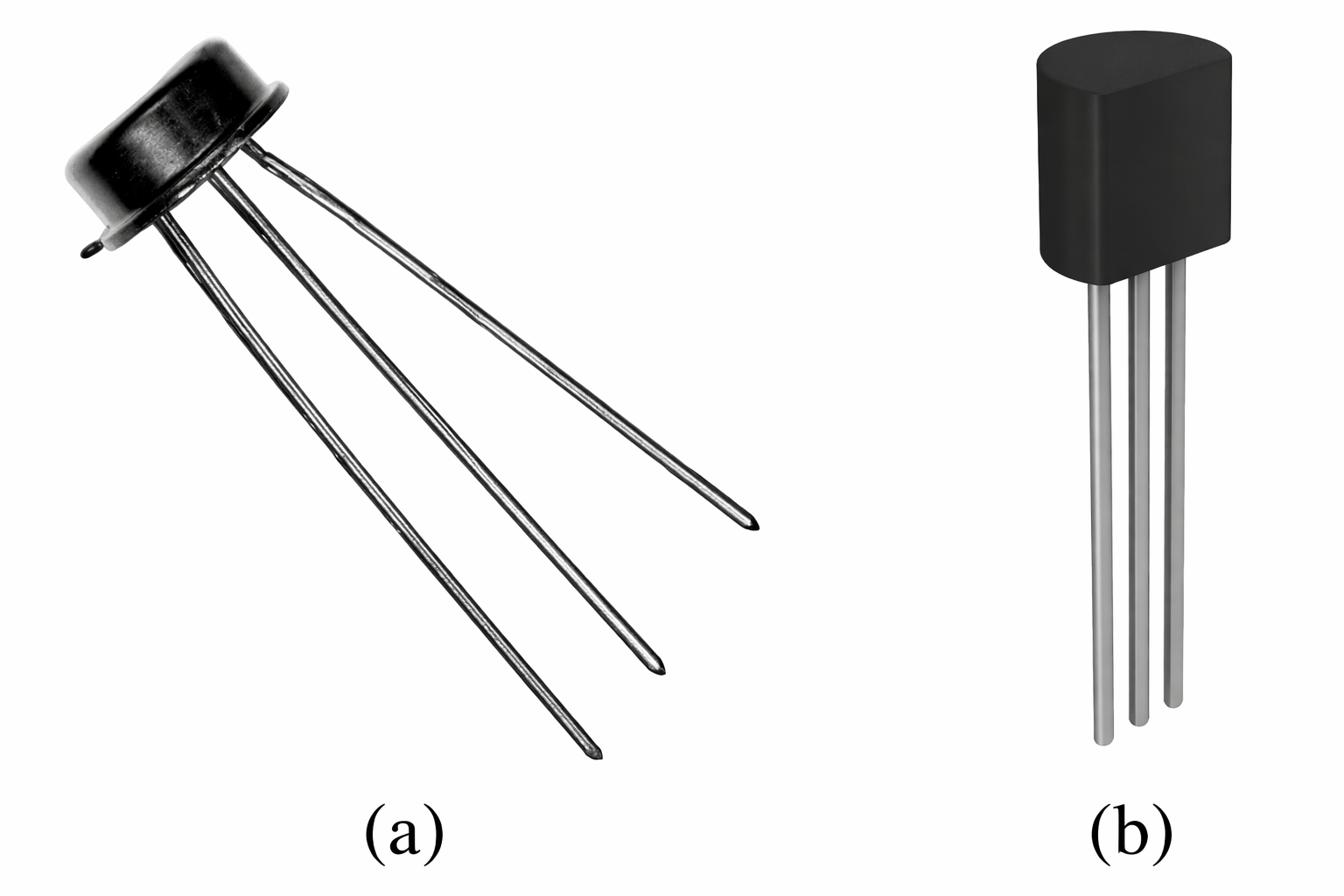
Figure 1. LM35C sensor (a) TO-46 metal can package and (b) TO-92 plastic package
The LM35C sensor is available in several packages (see Figure 1), including the hermetic TO-46 metal can package and the TO-92 plastic package. The sensor has three leads:
- one for 4 to 30 VDC input power,
- the other for ground, and
- the third for the analog voltage output from the sensor.
The analog output of the sensor is proportional to temperature in degrees C with a sensitivity of 10.0 mV/°C. This sensor is very suitable for use with microcontrollers since it draws little current (less than 60 μA), and its output is directly calibrated in degrees Celsius, thus avoiding any conversion operations.
Note that the LM35C is designed to measure temperature in ambient air and not to be immersed in a liquid. To use in a liquid, the sensor must be encapsulated.
Integrated Circuit Accelerometers
IC or MEMS (Micro-Electro-Mechanical Systems) accelerometers, leveraging silicon capacitive micromachined technology, are cost-effective sensors widely employed in applications like airbag deployment, computer hard drive protection, and virtual reality input devices.
Each accelerometer comprises a surface micromachined capacitive sensing cell (g-cell) and a CMOS signal conditioning circuit, both integrated within a single IC package. Manufactured using wafer processing techniques, the g-cell can be visualized, as depicted in Figure 2, as two stationary plates flanking a movable center plate.
- As the device experiences acceleration, the center plate deflects, altering the distance—and thus the capacitance—between itself and the stationary plates.
- The CMOS circuitry then translates these capacitance shifts into an interpretable output, representing the magnitude of acceleration.
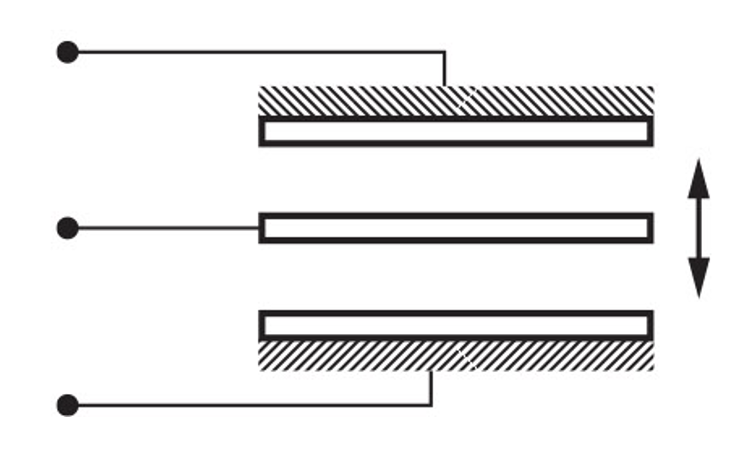
Figure 2. Model of a silicon capacitive micromachined accelerometer
IC accelerometers are designed for mounting on circuit boards. They come in various sensitivities and acceleration measurement ranges. Figure 3 depicts an ADXL335 3-axis IC sensor, produced by Analog Devices and mounted on a circuit board. This sensor boasts a sensitivity ranging from 270 to 330 mV/g and a measurement range of ±3 g.
Although the ADXL335 chip is rated for a 3 VDC input, when integrated with the Seeed board, users can provide an input voltage ranging between 3 and 5 VDC. A notable feature of this accelerometer is its ability to offer a separate analog output voltage for each x, y, and z acceleration it measures. These outputs can be easily read using an A/D converter.
IC accelerometers’ advantages include their affordability, low current consumption (less than 0.5 mA for this sensor), built-in signal conditioning, and linear output. Another benefit is that they do not necessitate a charge amplifier. However, their temperature operating range is narrower compared to charge output piezoelectric accelerometers, and they are not as robust. It is worth mentioning that many recent IC accelerometers favor digital outputs, like I2C or SPI, over analog outputs.
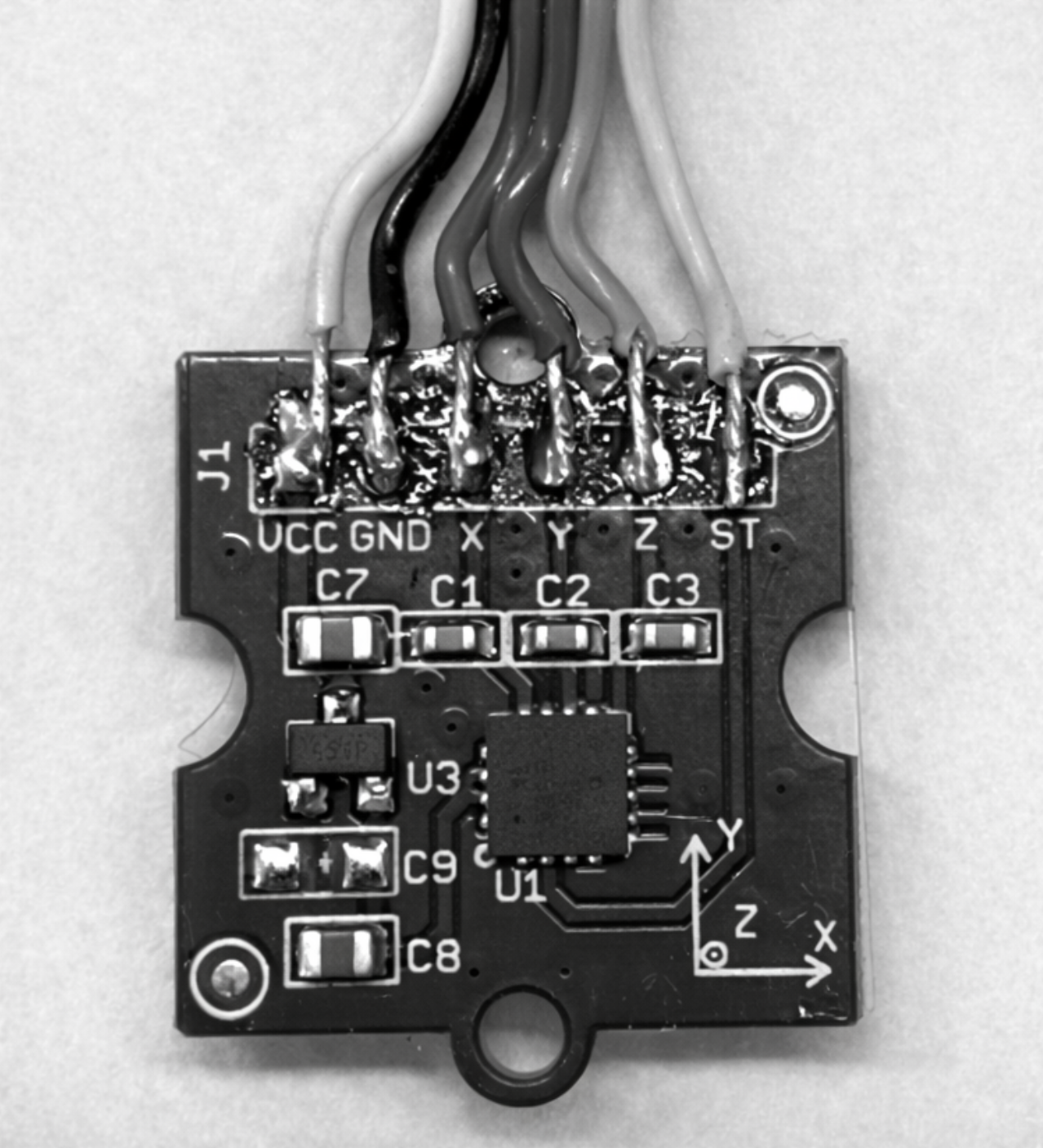
Figure 3. ADXL335 sensor
IC IMU Sensors
An Inertial Measurement Unit (IMU), also known as a motion sensor, is a highly versatile sensor used in a wide range of consumer and industrial applications to measure motion along multiple axes.
The fundamental IMU sensor consists of an accelerometer for measuring linear acceleration and a gyroscope for measuring rotational speeds. More advanced IMU sensors may also incorporate a magnetometer to determine a compass heading by measuring the Earth’s magnetic field.
In automotive applications, IMUs play a vital role in several areas, including lateral stability and traction control, emergency maneuver assistance, and adaptive suspension systems. It is worth noting that IMUs are available in both integrated circuit (IC) form and non-IC form, but this article will primarily focus on the IC form.
Most IMUs available today come with digital output rather than analog output. This digital output offers several advantages, including higher sensitivity compared to analog output. Many digital IMUs have a sensor output resolution of 16 or 32 bits, surpassing the typical 10-bit resolution of an analog-to-digital converter (ADC) used by microcontrollers to read analog IMU output.
Digital IMUs transmit data in a digital format through a serial interface such as SPI or I2C. Unlike analog IMUs, these sensors can be configured digitally. Most digital IMUs support features such as sensitivity adjustment, sampling rate modification, and even the ability to enable or disable specific functionalities like tap detection or free-fall detection.
Key Takeaways
IC sensors have become foundational components in modern embedded and industrial systems because they offer compact size, low power consumption, integrated signal conditioning, and straightforward digital interfacing. By combining sensing and processing on a single chip, these devices simplify system design, reduce noise and wiring complexity, and improve reliability compared to discrete sensor implementations. From temperature monitoring and motion detection to automotive stability systems and consumer electronics, IC sensors enable scalable, cost-effective measurement solutions that support the growing demand for intelligent, connected, and data-driven applications.