This article discusses the essential functions of amplifying systems, focusing on how voltage and power gain are achieved and applied in multi-stage amplifier configurations.
Overview of Amplifying Systems
Amplifying systems are widely used in electronic equipment to increase the power, voltage, or current of AC signals. An amplifying system may be only one part or section of a rather large and complex system. A television receiver is a good example of this application. Several individual amplifying systems are included in a television receiver, such as audio and video amplifiers. A DVD player, by comparison, has only one amplifying system. Its primary function is to process a sound signal and build it to a level that will drive a speaker. Transistors and integrated circuits are the basic devices used for this type of operation. The function of an amplifier is basically the same regardless of its application: to amplify a signal.
Amplifying devices are used in an amplifying system to perform specific circuit functions such as voltage and power gain, coupling, and signal processing. Input and output transducers, such as microphones and speakers, are also part of the operation of an amplifying system.
Regardless of its application, an amplifying system has a number of primary functions that must be performed. These functions are energy conversion, amplification, and power distribution. An understanding of these functions is an extremely important part of operational theory. To understand these functions, it is essential to be familiar with concepts such as amplifier gain, decibels, and frequency response.
Major Functions of an Amplifying System
The major functions of an amplifying system are energy conversion, amplification, and power distribution. These functions are achieved through the input transducer, amplifier, power supply, and output transducer. A block diagram of an amplifying system is shown in Figure 1. The triangular-shaped items of the diagram show where the amplification function is performed. A stage of amplification is represented by each triangle. Three amplifiers are included in this particular system.
A stage of amplification consists of active devices (usually transistor circuits) and all associated components. Small-signal amplifiers are used in the first three stages of this system. The amplifier on the right side of the diagram is an output stage. A rather large signal is needed to control the output amplifier. An output stage is generally a power amplifier, or a large-signal amplifier. In effect, this amplifier is used to control a rather large amount of current and voltage. Remember, power is the product of current and voltage.
In an amplifying system, a signal must be developed and applied to the input. The source of this signal varies a great deal with different systems. In a DVD player, an audio signal is produced. Variations in electronic signals are changed into sound energy. The amplitude level of the electronic signal is increased to a suitable level by amplifying devices. A variety of different input signal sources may be applied to the input of an amplifying system.
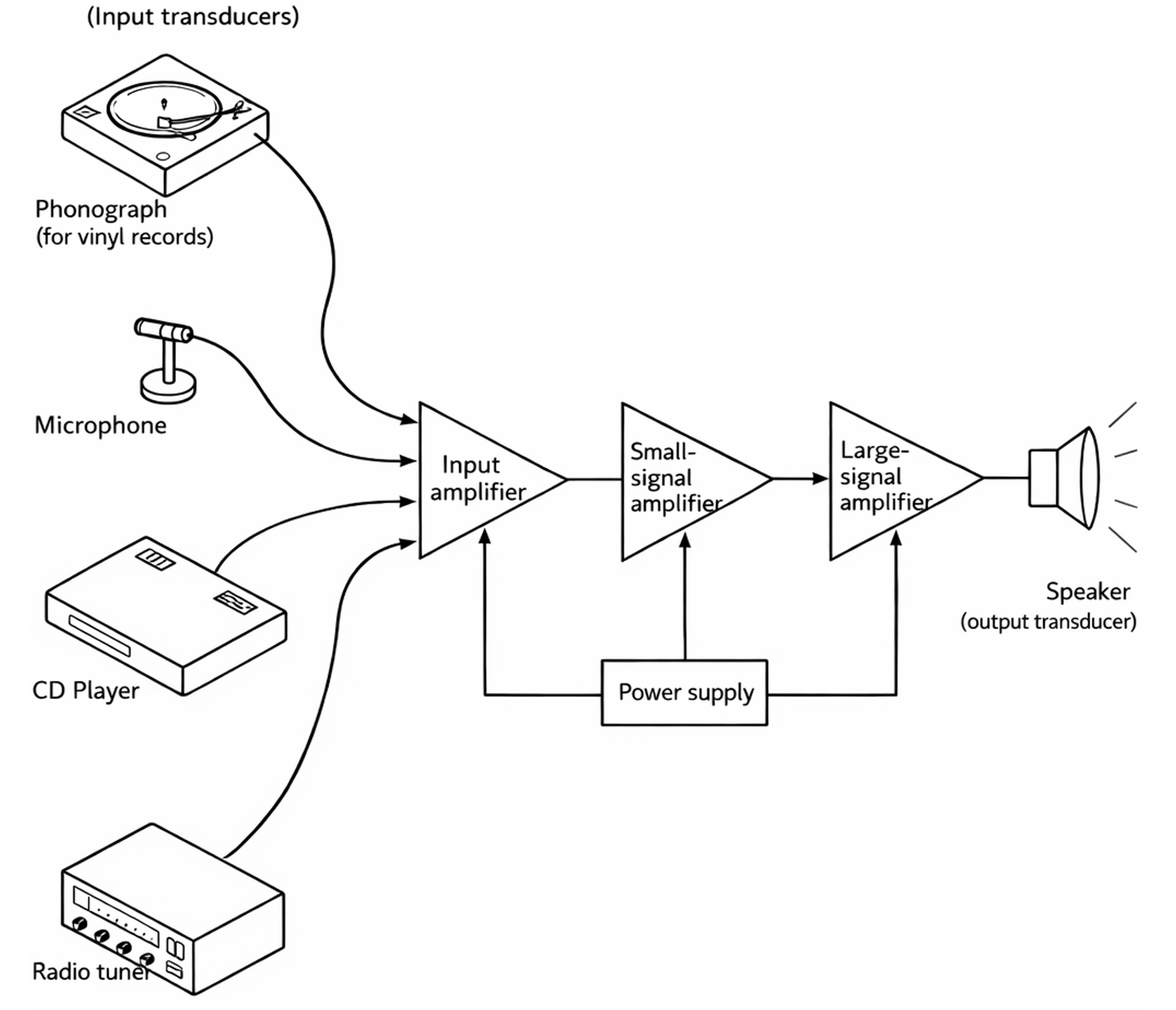
Figure 1. Amplifying System Block Diagram
In other systems, the signal is also developed by the input. An input transducer is responsible for this function. A transducer changes the energy of one form into energy of a different form. Several types have been used over the years for home entertainment systems. Microphones, vinyl phonograph pickup cartridges, CD players, and DVD players are input transducers. Input signals may also be received through the air. Antennas may serve as the input transducer for this type of system. An antenna changes electromagnetic waves into radio frequency (RF) voltage signals. The signal is then processed through the remainder of the system.
Signals processed by an amplifying system are ultimately applied to an output transducer. This type of transducer changes electrical energy into another form of energy. In a sound system, the speaker is an output transducer. It changes electrical energy into sound energy. The speaker performs work when it achieves this function. Lamps, motors, relays, transformers, and inductors are frequently considered to be output transducers since they perform work. An output transducer is considered to be the load of a system.
For an amplifying system to be operational, it must be supplied with electrical energy. A DC power supply performs this function. A relatively pure form of DC must be supplied to each amplifying device. In most amplifying systems, AC is the primary energy source. AC is changed into DC, filtered, and, in some systems, regulated before being applied to the amplifiers. The reproduction quality of the amplifier depends, to a large extent, on the quality of the DC power supply. Batteries may also be used to energize some portable stereo amplifiers.
Voltage and Power Gains of Amplifier Systems
You should recall that the gain of an amplifier system can be expressed in a variety of ways. Voltage, current, power, and, in some systems, decibels, are expressed as gain. Nearly all input amplifier stages are voltage amplifiers. These amplifiers are designed to increase the voltage level of the signal. Several voltage amplifiers may be used in the front end of an amplifier system. The voltage value of the input signal usually determines the level of amplification achieved.
A three-stage voltage amplifier is shown in Figure 2. These three amplifiers are connected in cascade. The term cascade refers to a series of amplifiers in which the output of one stage of amplification is connected to the input of the next stage of amplification. The voltage gain of each stage can be observed with an oscilloscope. The waveform shows representative signal levels. Note the voltage-level change in the signal and the amplification factor of each stage.
The first stage has a voltage gain of 5. This means that with an input of 0.25 $V_{pp}$ and a total gain of 100, the output is 1.25 $V_{pp}$. The second stage also has a voltage gain of 5. With 1.25 $V_{pp}$ input, the output is 6.25 $V_{pp}$. The output stage has a gain factor of 4. With a 6.25 $V_{pp}$ input, the output is 25 $V_{pp}$.
The total gain of the amplifier is $5 \times 5 \times 4 = 100$. Therefore, with 0.25 $V_{pp}$ input, the output is 25 $V_{pp}$. Note that the output is the product of the individual amplifier gains. It is not just the addition of $5 + 5 + 4$. Voltage gain ($A_{V}$), you should recall, is an expression of output voltage ($V_{out}$) divided by input voltage ($V_{in}$). For the amplifier system, $A_{V}$ is expressed by the following formula:
$$A_{V} = \frac{V_{out}}{V_{in}} = \frac{25 V_{pp}}{0.25 V_{pp}} = 100$$
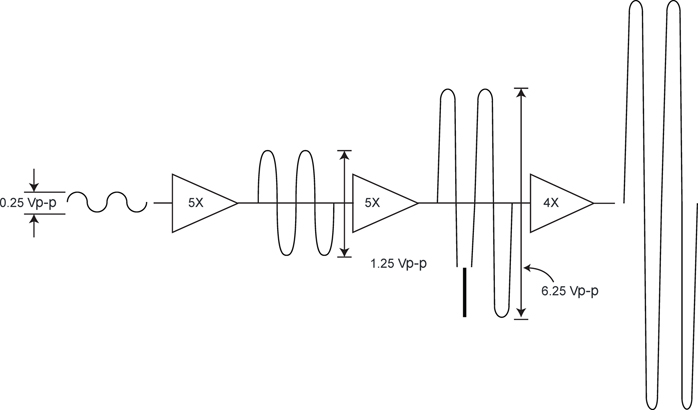
Figure 2. Three-stage voltage amplifier gain.
Note that the units of voltage cancel each other in the problem. Voltage gain is, therefore, expressed as a unitless value, such as 100.
Power gain is generally used to describe the operation of the last stage of amplification. Power amplification ($A_{P}$), you should recall, is equal to power output ($P_{out}$) divided by power input ($P_{in}$). If the last stage of amplification in Figure 2 were a power amplifier, its gain would be expressed in watts rather than volts. In this case, the gain would be:
$$A_{P} = \frac{P_{out}}{P_{in}} = \frac{25 W}{6.25 W} = 4$$
Note that the power units of this problem also cancel each other. Power amplification is expressed as a unitless value, such as 4.
Example 1
Calculate $A_{V}$ with a voltage input of 0.5 $V_{pp}$ and an output voltage of 12 $V_{pp}$.
Solution
$$A_{V} = \frac{V_{out}}{V_{in}} = \frac{12 V_{pp}}{0.5 V_{pp}} = 24$$
Review Questions
- The voltage gain $A_{V}$ is calculated using the formula ______.
- In a three-stage amplifier system, the overall voltage gain is the ______ of the gains of each stage.
- The function of an output transducer in an amplifying system is to convert ______ into another form of energy.
- The unit used to express power gain is ______.
- Devices like microphones and antennas serve as ______ transducers.
Answers
- $\frac{V_{out}}{V_{in}}$
- Product
- Electrical energy
- Unitless
- Input
Key Takeaways
Amplifying systems play a central role in signal processing by increasing voltage or power to suitable levels. Voltage gain is essential in the initial stages to strengthen weak input signals, while power gain ensures effective energy delivery to output devices. Cascading amplifier stages allows for greater overall gain and better control of signal levels.